

Most companies hiring internationally as contractors aren’t doing anything wrong on day one. The arrangement works. The person delivers. Invoices get paid. Nobody shows up at your door.
That’s exactly why it’s dangerous.
And this is the part that catches people off guard - misclassification risk doesn’t build like a leak you can hear. It builds like debt you can’t see. Every month that passes, every Slack message directing their schedule, every company tool you hand them, every deadline you set - that’s evidence stacking up in a file nobody’s reviewing yet.
Until someone does.
The most common thing I hear is some version of: “We’ve been doing this for two years and nothing’s happened.” I get it. Two years of nothing feels like proof. It’s not. It’s just a longer fuse.
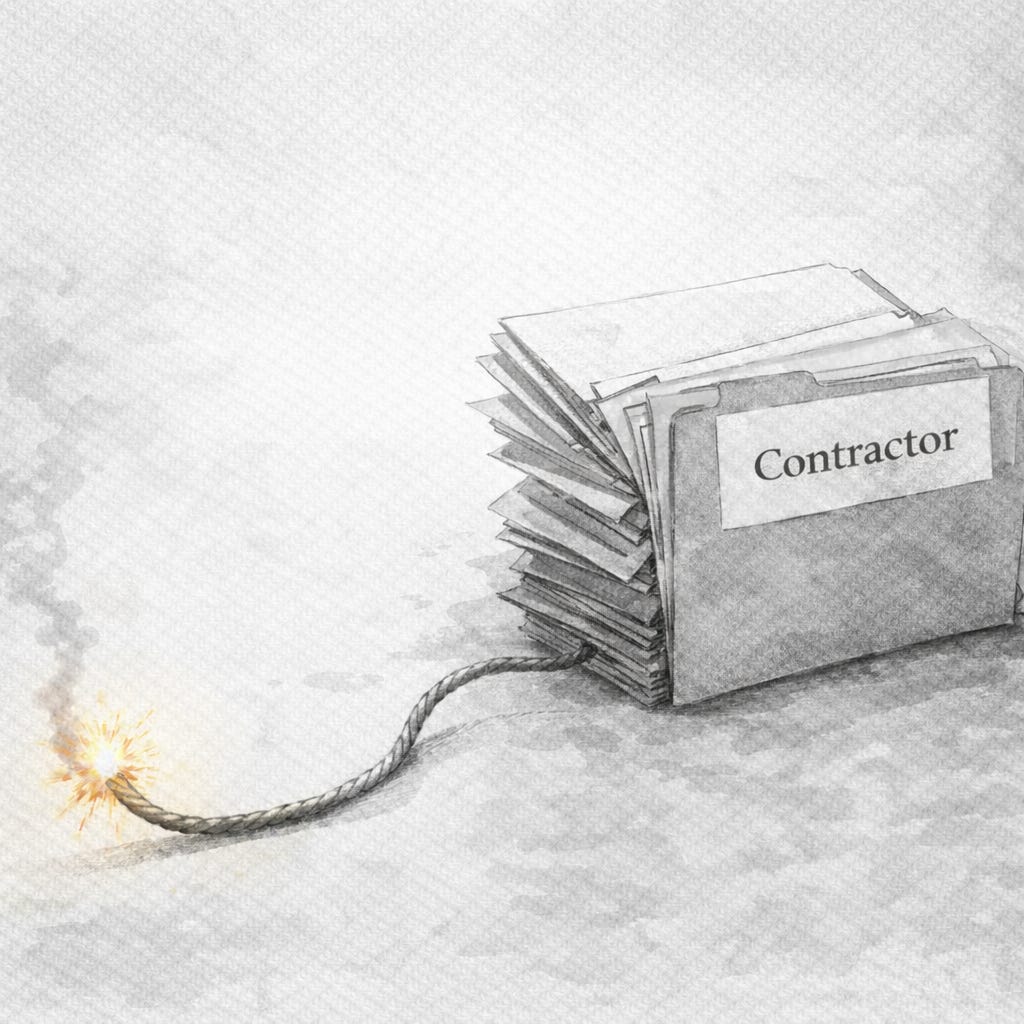
The real question is what happens when it blows. And that varies wildly by country - more than most people realize.
Germany is one of the stricter environments. If a German tax authority decides your contractor is actually an employee, you’re looking at backdated social security contributions for both sides - yours and theirs. The employer portion alone can run 20%+ of total compensation. For two years. Retroactively. Plus penalties on top. Germany also has a concept called “Scheinselbstständigkeit” - fake self-employment - and they take it seriously. The criteria they use aren’t just about contracts. They look at how the work actually happened.
Argentina is a different kind of problem. Employment law there is heavily weighted toward workers. If someone is reclassified as an employee, the company can be on the hook for statutory severance, unpaid benefits, and contributions going back to day one. Argentina also has high inflation, which means the peso values shift but the liability calculates based on what was owed at the time. The math gets ugly fast.
South Africa has its own version. Labor courts there have increasingly sided with workers claiming employee status even when contracts said otherwise. The key test isn’t the contract language - it’s the economic reality of the relationship. Did they work exclusively for you? Did you control how the work was done? Those answers matter more than what the agreement says.
This is the part people miss. Most founders and HR leads assume that having a contract calling someone a contractor is the protection. It’s not. Every country with meaningful enforcement uses a substance-over-form test. They look at the actual relationship, not the document.
I wrote an article on this on Employ Borderless, I’ll attach the link here: https://employborderless.com/eor/vs-cor/
The silence is what compounds it. Unlike a bad hire or a missed deadline, misclassification has no obvious signal while it’s happening. The contractor doesn’t know to flag it. Your finance team isn’t tracking the exposure. Legal isn’t involved because nothing has gone wrong yet. By the time someone raises a hand, you’re often looking at years of accumulated liability.
From what I’ve seen, the companies that get hit hardest are the ones who grew fast. They hired a few contractors across a few countries, it worked operationally, they added more, nobody paused to ask whether the classification still held. Then they try to raise a round, or get acquired, and due diligence surfaces it. Or a contractor leaves unhappy and files a complaint. Or a local authority runs an audit.
The other thing worth knowing: the person you hired often has no idea this is coming either. Reclassification doesn’t just hit the company. In some countries, the worker suddenly has tax obligations they weren’t planning for. Benefits they were supposed to receive but didn’t. It creates a mess on both sides.
I’ve spent a decade watching companies handle global hiring. The contractor question comes up constantly, and the answer is almost always the same: it works until it doesn’t, and the gap between those two states is invisible.
Two years of nothing is not a green light. It’s just two years.