

When a company hires through an EOR, someone becomes the legal employer of that worker.
Here’s the uncomfortable part: most companies signing those contracts couldn’t tell you who.
Some providers employ your workers through entities they own. Others route employment through local partners - companies you’ve never heard of, didn’t choose, and can’t audit. Many do both, while marketing themselves under a single brand name.
The owned-entity vs partner-network debate is everywhere in this space. Owned-entity providers publish articles explaining why partner networks mean inconsistent service and diluted accountability. Partner-network providers publish articles explaining why owned entities lack real local expertise.
Both sound reasonable. Both are grading their own homework.
I went looking for independent research. Peer-reviewed studies, regulatory analysis, anything not written by someone selling one of the structures. I found nothing. The most consequential structural question in a multi-billion dollar market is answered exclusively by the sellers.
So I wrote the framework I wished existed. It’s my second research paper, following the taxonomy of EOR, PEO, global payroll, and contractor of record I published in March. Open access on Zenodo.
The wrong question
The owned vs partner debate, as it’s conducted, isn’t answerable. And it doesn’t need to be.
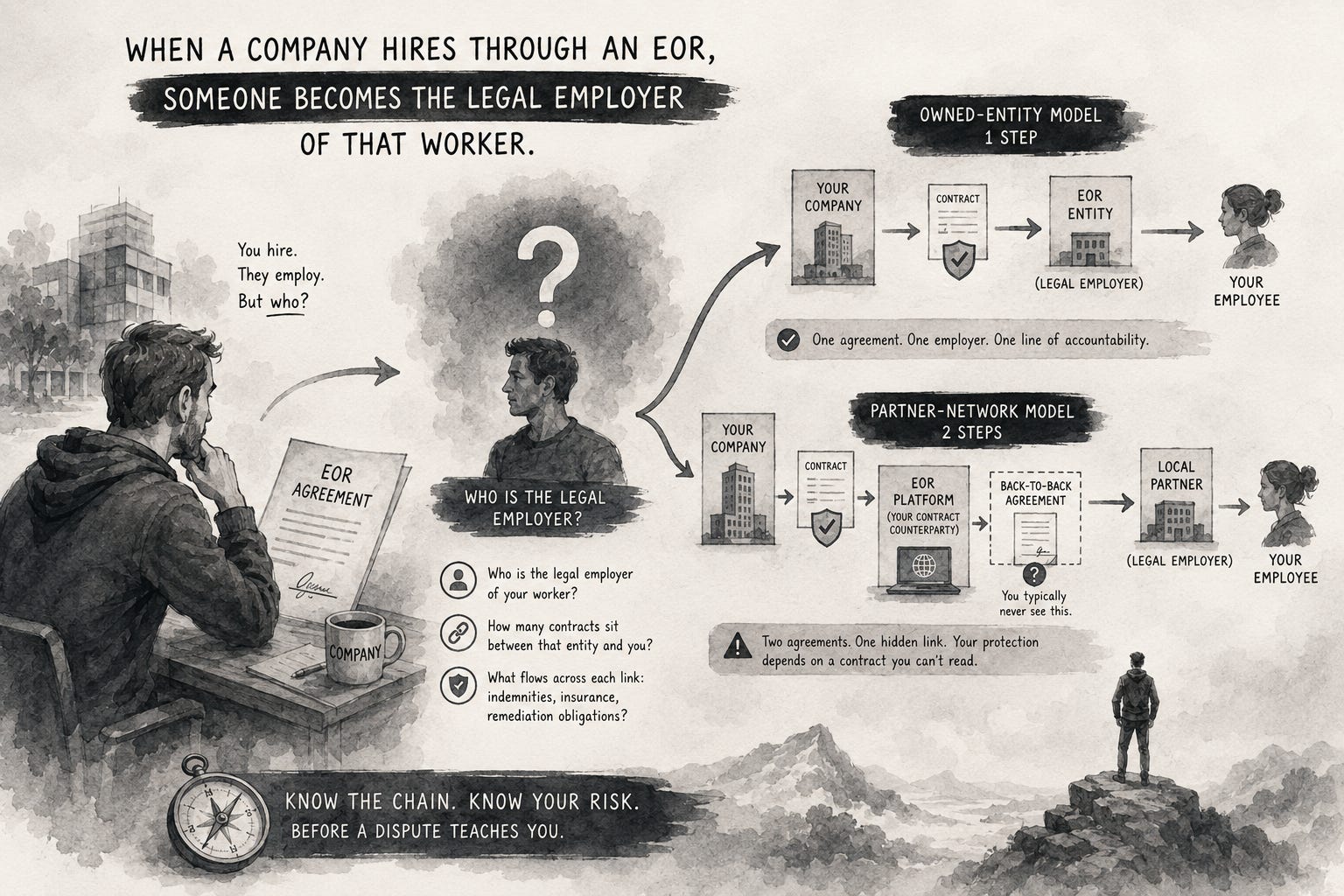
You don’t need to know which model is better in general. You need to know three things, for each country you’ll hire in:
Who is the legal employer of your worker
How many contracts sit between that entity and you
What flows across each link: indemnities, insurance, remediation obligations
I call this the liability chain.
With an owned-entity provider: one step. The company you can sue and the company employing your worker belong to the same group.
With a partner network: two steps. Your contract is with the platform. The employment sits with a local partner. And the agreement between the two - the link that actually protects you - is one you’ll typically never see. Your protection depends on back-to-back terms in a contract you can’t read.
Neither structure is defective. But they are different products. Know which one you’re buying before a dispute teaches you.
The label problem
The vendor debate gets worse when you look at what the labels actually describe.
Many providers own entities in their core markets and use partners everywhere else. One client, one invoice, one dashboard - two completely different structures, depending on which country you’re hiring in.
The only reliable unit of analysis is the country.
Which is why the framework starts here: ask the provider to name the legal employing entity for each country in scope, in writing. A provider that won’t answer has already failed the evaluation.
What else the framework covers
The structural setup gets most of the attention. Five other things don’t get enough:
Coverage depth in your specific countries (not just the headline number)
Total cost of engagement beyond the monthly fee
Data flow and where your employee data actually lives
Offboarding portability: can you extract your people cleanly if you switch
Provider viability: what happens to your workers if the company fails
Each has a core question and a red flag. The paper sequences all of it into a decision protocol that starts before you shortlist and ends with negotiating the exit before you sign the entry.
What I couldn’t do
One honest limitation.
This is a conceptual paper. I make no claim that either model produces better outcomes, because the evidence doesn’t exist. Nobody has gathered comparative data on compliance incidents or dispute resolution across EOR structures. Until someone does, every outcome claim in this market, including the ones in provider marketing, is untested.
That gap is documented in the paper as a formal research question. I hope someone with the data closes it.
Full paper, open access, no paywall: https://doi.org/10.5281/zenodo.21120024
If you work in legal, HR, or procurement and have seen these structures tested in practice, I want to hear about it. That’s exactly what the next paper needs.