

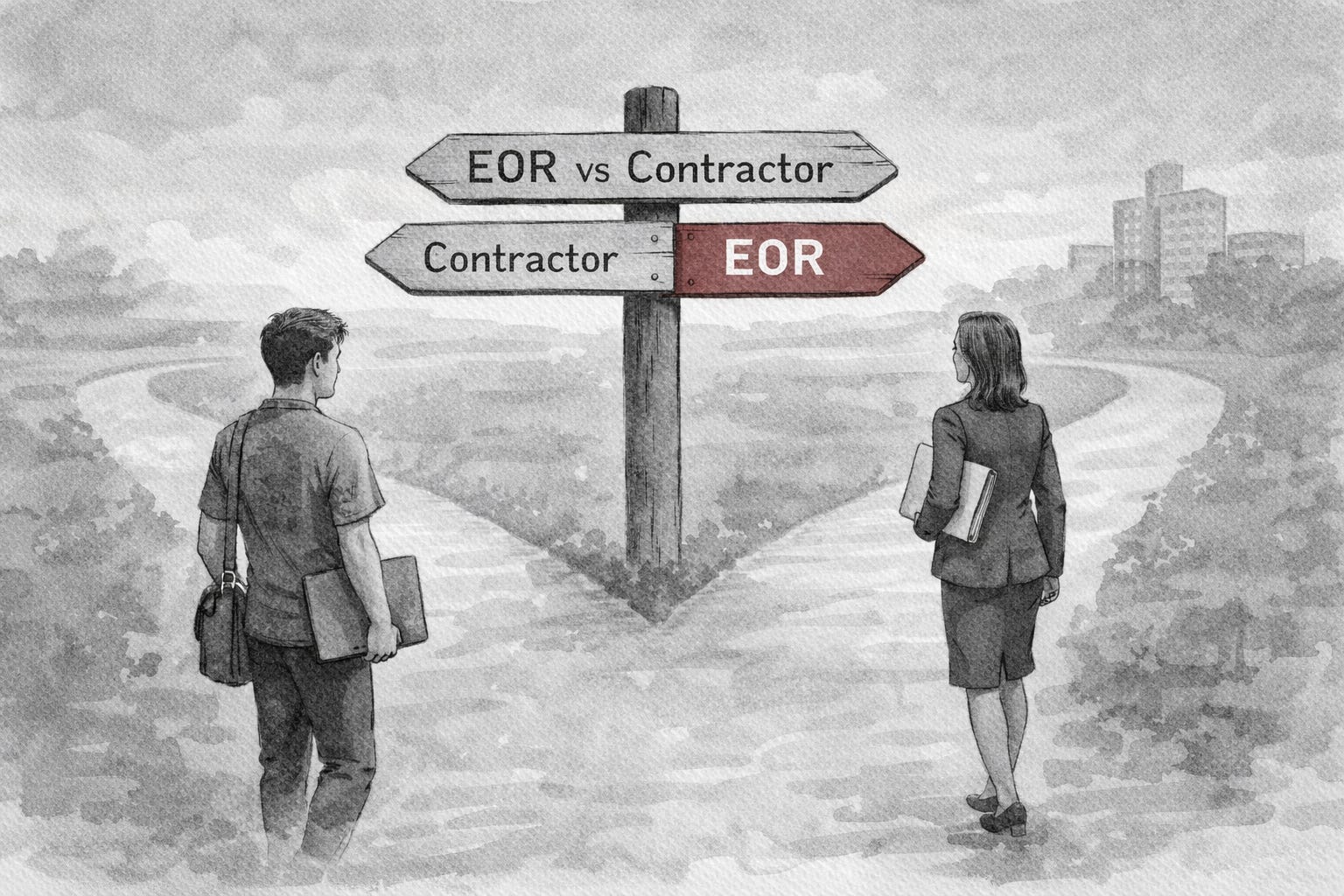
Most companies overthink their first international hire. They see all these acronyms - EOR, PEO, contractor of record - and assume it’s rocket science.
It’s not.
Here’s what actually happens. You want to hire someone in Germany but you don’t have a German entity. You have two main options.
Option one: hire them as a contractor through a contractor of record service. This is faster and cheaper upfront. Takes maybe a week to set up. The person stays an independent contractor legally.
Option two: hire them as a full employee through an Employer of Record. This takes longer, costs more, but gives you and the worker full employment protections.
From what I’ve seen over the past years, most companies follow the same pattern. They start with contractor of record for their first hire. Test the waters. See if the person works out.
Once they’re confident about the hire - usually after 3-6 months - they convert to EOR. Now the person becomes a proper employee with benefits, vacation days, and job security.
I made a short YouTube video for whoever is interested.
The Employer of Record becomes the legal employer in that country. They handle payroll, taxes, compliance, benefits. You manage the day-to-day work. Think of it like outsourcing HR and legal stuff to someone who already has the setup in place.
The contractor route works fine short-term. But it gets messy if the person starts acting like an employee. Working set hours, using company equipment, taking direction like staff. Tax authorities don’t like when contractors look too much like employees.
That’s why the progression makes sense. Start as contractor to test the relationship. Move to EOR when you want them as permanent team members.
The whole industry has gotten better at making this simple. Most providers now offer both contractor and EOR services. You can start with one and switch to the other without changing platforms.
I’ve tested over 50 different providers. The mechanics are mainly the same everywhere. You fill out forms, provide documents, they handle the legal setup. The differences are in speed, cost, and how much hand-holding you get.
What trips people up is thinking they need to understand all the employment laws in each country. You don’t. That’s literally what you’re paying the EOR to handle.
The real decision is timing. Contractors work for short-term projects or when you’re unsure about the hire. EOR makes sense when you want someone as a permanent team member.
Most companies I talk to wish they’d started sooner. They spend months researching and planning when they could have had someone working in a few weeks.
The pattern I keep seeing is this: companies that move fast on their first international hire end up building better global teams. They learn by doing instead of planning.
From a practical standpoint, the contractor-to-EOR path gives you flexibility. Low commitment initially, full employment relationship later. Most providers make the transition smooth.
The costs aren’t as scary as people think either. Contractor services usually run 5-10% of salary. EOR services are typically 15-25%. Yes, it’s an expense, but it’s predictable and includes everything.
I spent years overcomplicating this before I realized the basic mechanics are straightforward. You want to hire internationally, you need local compliance, these services provide that foundation.
The industry has matured enough that the main providers handle the complex stuff reliably. Your job is picking the right one for your specific situation, not becoming an expert in German employment law.