

Before I recommend anything, I ask three questions. Every time. Because the wrong answer to any one of them changes everything.
Companies pick EOR providers for the wrong reasons. They read a comparison article, pick the one with the most polished landing page, and sign a contract. Then six months later they’re frustrated, overpaying, or stuck in a structure that doesn’t fit what they actually need.
So here’s how I actually think through it.
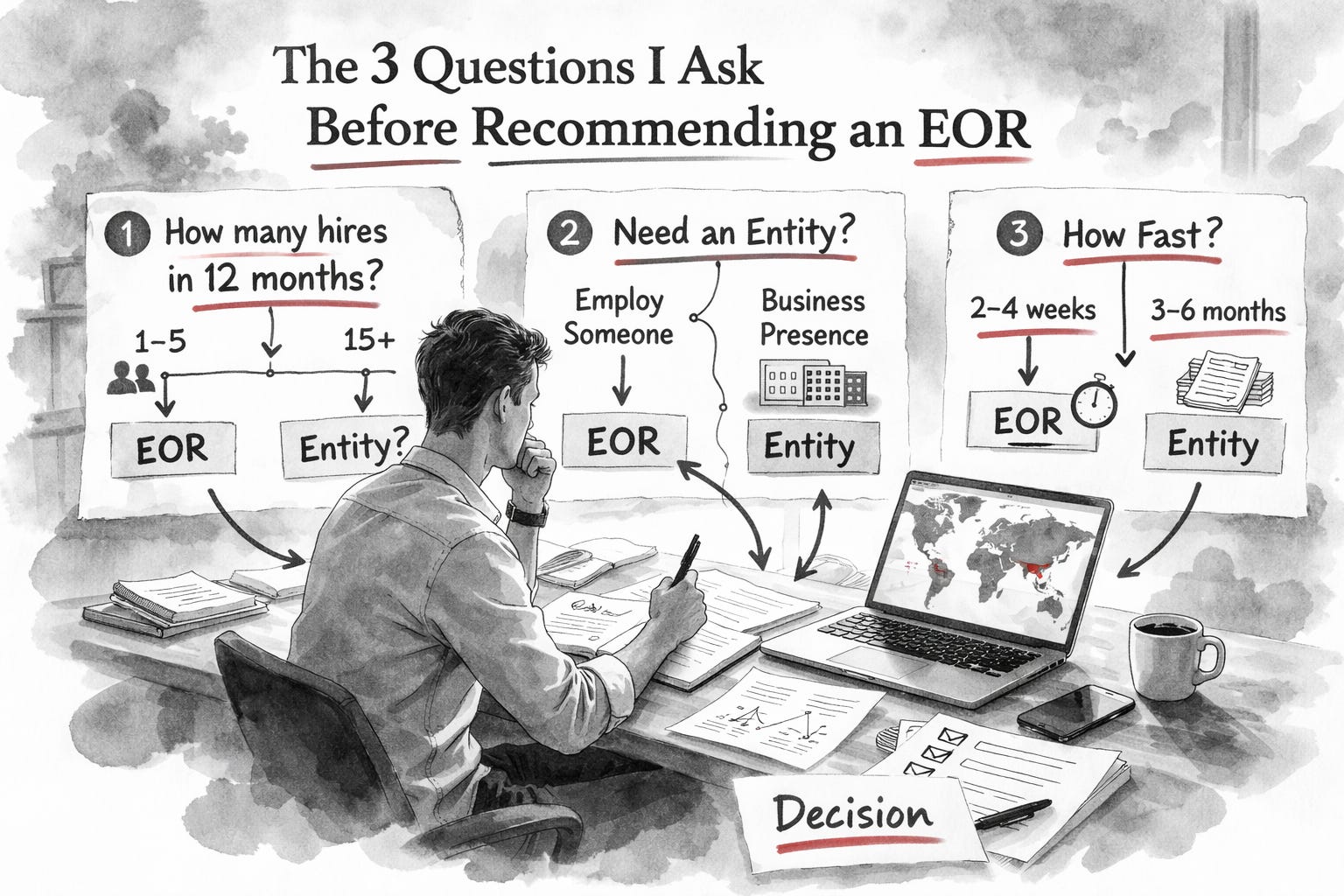
First question: how many people are you planning to hire in this country over the next 12 months?
This one matters more than people realize. If the answer is one to five, EOR almost always makes sense. You’re not big enough to justify the cost and complexity of your own entity. The math doesn’t work. Setting up a legal entity in most countries costs anywhere from $5,000 to $30,000 in legal and admin fees alone, and that’s before you think about ongoing compliance, local accounting, and HR overhead.
But if the answer is fifteen or more, the calculation flips. At that scale, your EOR fees start to look like rent you’re paying on someone else’s building. You’re funding their entire operation when you could be building your own. Not always - there are exceptions - but the number fifteen is roughly where I start asking harder questions.
Second question: do you actually need a local entity, or do you just need to employ someone?
And here’s what most people miss. These are two completely different problems. And people mix them up constantly.
An EOR solves the employment problem. You can hire someone in a country where you have no legal presence. They get a proper employment contract, local benefits, compliant payroll. Done. The EOR is the legal employer on paper, you’re running the work.
What an EOR doesn’t solve is the business reason for being in that country. If you need to sign local contracts, hold a local banking license, bid on government work, or operate as a recognized local company - that’s an entity problem. EOR won’t fix it.
From what I’ve seen, most companies hiring their first employee abroad don’t actually need an entity. They need a person. They’ve conflated the two because someone told them “you need to set up locally” without asking why.
If the real reason is “we want someone on the ground who can do the work” - EOR handles that cleanly. If the reason is “we need to be a registered business in that market” - different conversation entirely.
Third question: how fast do you need this person to start?
This one cuts through a lot of indecision.
Setting up your own entity takes three to six months in most countries. Sometimes longer. There’s registration, tax IDs, local bank accounts, HR policies, payroll setup. It’s not complicated, but it’s slow. Bureaucracy moves at its own pace.
An EOR can get someone employed in two to four weeks. Sometimes faster. The systems are already in place. You’re plugging into something that exists.
If you have a hire who’s sitting on a competing offer and needs an answer in two weeks - entity setup isn’t a real option. Even if the long-term math eventually favors an entity, the short-term reality doesn’t.
I’ve talked to enough companies to know that urgency often drives the EOR decision more than anything else. Someone found a great candidate, they need to move, and they don’t have six months to wait on legal setup. EOR wins by default.
What I find interesting is how rarely these three questions get asked before someone starts Googling “top-rated EOR provider.” People jump straight to vendor comparison when they haven’t figured out what they actually need yet.
The provider question is the last question. Not the first.