

Most people assume the United States is one of the most expensive countries in the world to employ someone.
By law, it isn’t.
The United States ranks 158th out of 192 countries for statutory employer burden, making it one of the cheapest places in the world to employ someone under statutory law.
That tends to surprise people because American salaries are high. “Expensive” is the default assumption. But salary is only one part of the cost of employment, and often the part that varies the least.
What really changes employer cost is the statutory layer. What employers are legally required to pay in social security contributions. What they owe when employment ends. How much notice they must provide.
Those obligations are rarely compared consistently across countries.
So I measured them.
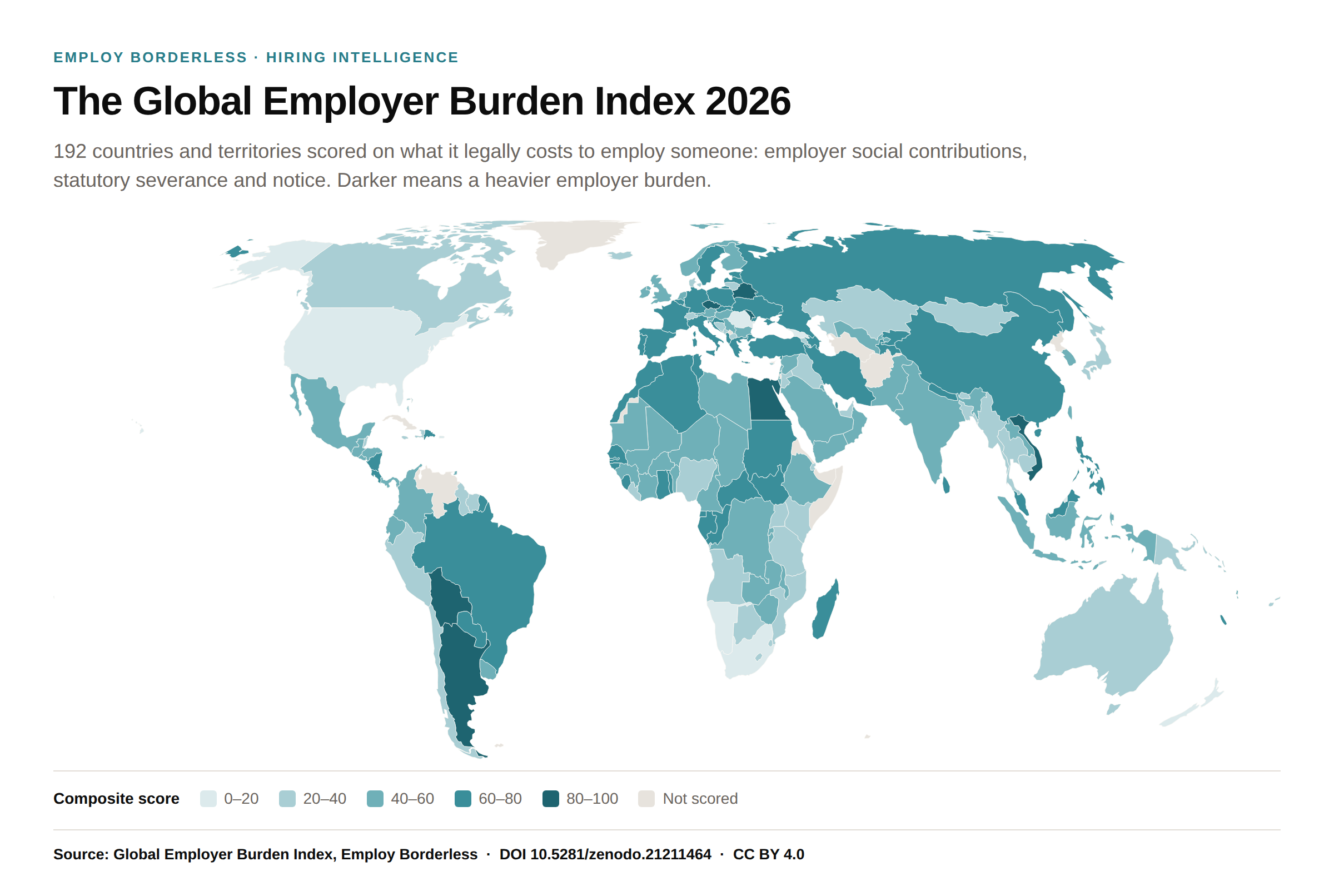
The result is the Global Employer Burden Index, an independent ranking of 192 countries and territories based on the statutory cost of employing someone. Every input is sourced and dated. The dataset is open. It is permanently archived on Zenodo with its own DOI. There are no estimates and no AI-filled gaps.
Here is what the data revealed, and why I built it this way.
What employer burden actually means
The index measures three statutory obligations that employers cannot negotiate away.
Employer social security contributions (50%)
Statutory severance (30%)
Statutory notice periods (20%)
Each pillar is ranked against every other country and combined into a composite score from 0 to 100, where a higher score represents a heavier statutory employer burden.
Employer social security contributions receive the highest weighting because they affect every employee on every payroll. Severance and notice matter too, but they usually become relevant only when employment ends.
One principle shaped the entire project.
A country is included only when I could verify all three pillars from reliable sources.
If a value could not be sourced with confidence, I did not estimate it. I did not interpolate it. I did not ask AI to fill in the blanks.
I excluded it.
As a result, 58 countries and territories remain outside the ranking because one or more statutory pillars could not be supported by reliable source material.
I would rather show the gaps than create false precision.
The biggest surprise
The United States is the headline, and the numbers hold up.
It has:
No federal statutory severance requirement
No statutory notice requirement
Employer social security contributions of roughly 8%
Together, that gives the United States the lightest statutory employer burden in the G7, despite having some of the highest salaries in the world.
The easiest way to see the difference is through a single employee.
Take someone earning $50,000 per year.\
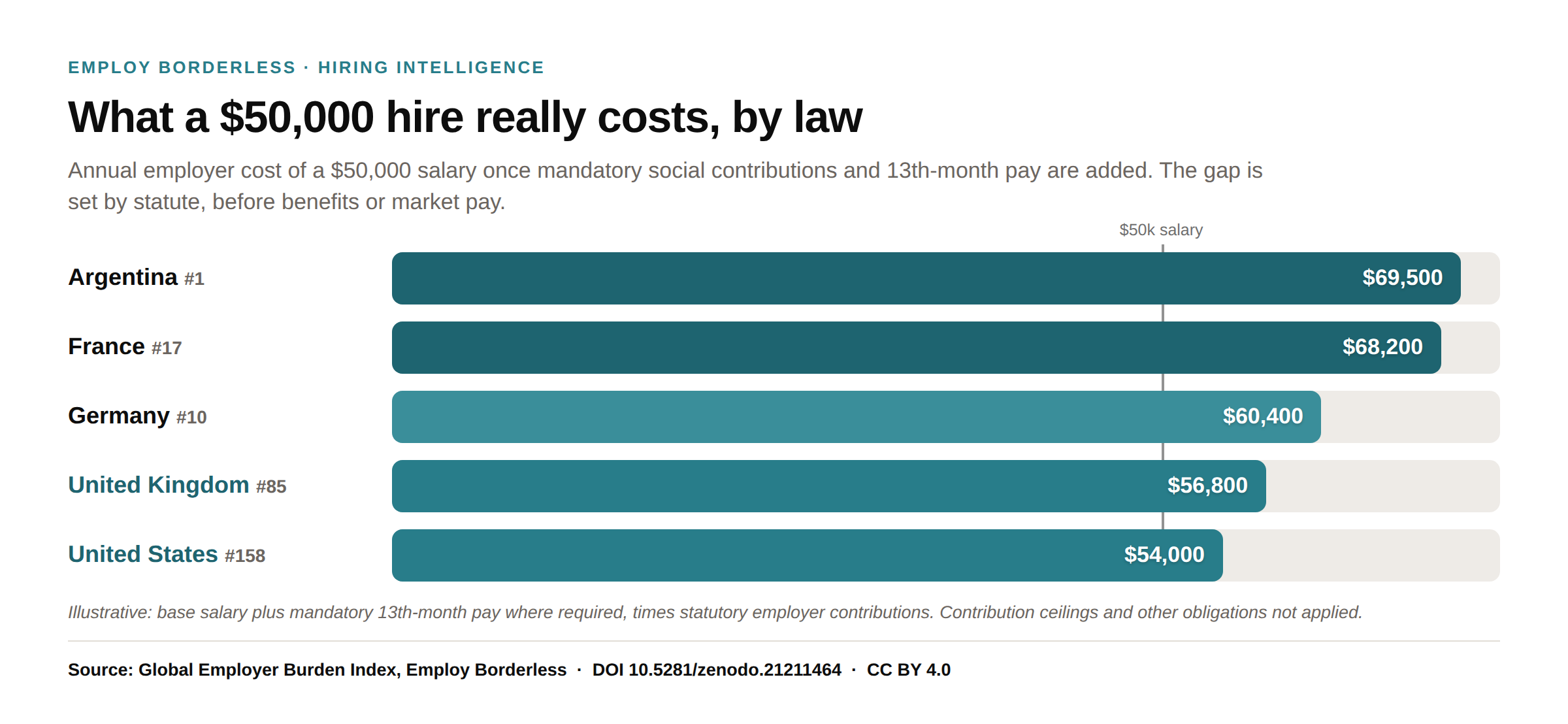
Adding only what the law requires produces very different employer costs.
United States: about $54,000
United Kingdom: about $56,800
Germany: about $60,400
France: about $68,200
Argentina: about $69,500
Same salary.
Roughly $15,000 difference.
Entirely created by statutory obligations before benefits, bonuses, or market compensation even enter the conversation.
Why Argentina tops the ranking
Here is something that surprised even me.
On that same $50,000 salary, Italy costs about $71,300 and Spain about $70,700. Both are higher than Argentina.
So why does Argentina rank first?
Because the index does not measure employer contributions alone.
It measures employer contributions, statutory severance, and statutory notice together.
Italy and Spain are expensive every month because employer contributions are high.
Argentina combines high employer contributions with some of the longest statutory severance and notice obligations anywhere in the dataset.
Monthly payroll tells one story.
The cost of ending employment tells another.
Looking at both is exactly why the index scores three statutory pillars instead of relying on a single “cost of hiring” number.
Other findings that stood out
A few more numbers surprised me.
Thirty-eight countries and territories have no statutory severance requirement at all.
In those markets, the cost of ending employment shifts toward notice periods, employment contracts, and negotiation rather than mandatory severance.
At the opposite end of the ranking, New Zealand carries the lightest statutory employer burden of any scored country.
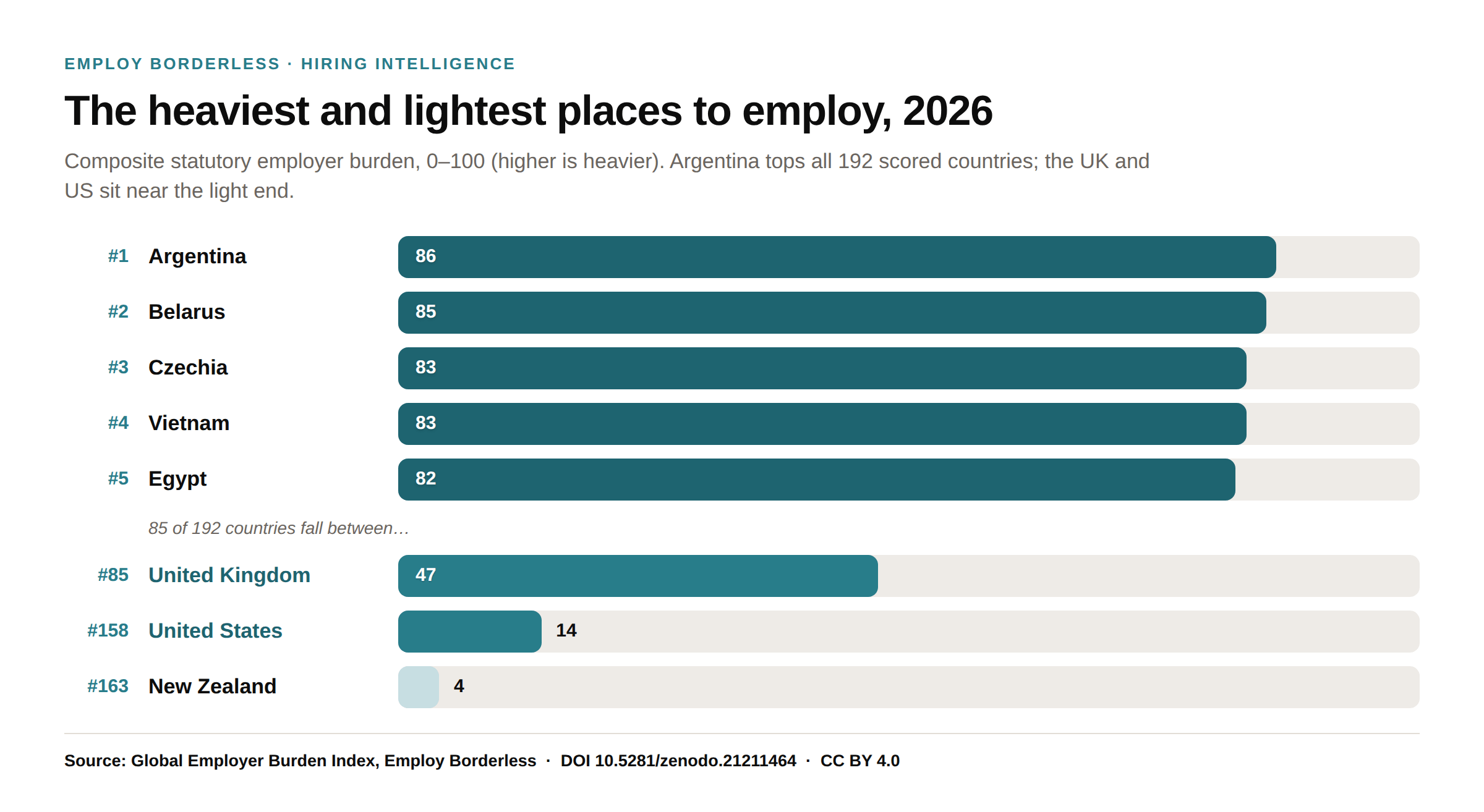
These differences rarely appear in salary benchmarks, yet they can materially change what employers pay over the life of an employee.
Why this matters
If you hire internationally, statutory obligations are the part you cannot negotiate.
You can adjust salary.
You can redesign benefits.
You can choose a different employer of record.
But you cannot opt out of a country’s employer contribution rates, statutory severance laws, or notice requirements.
That means the best time to understand those obligations is before deciding where to hire, not after your finance team discovers them during payroll or your legal team encounters them during a termination.
That is why I built this index.
Not to crown winners and losers.
To make one of the least transparent parts of global hiring easier to understand, compare, and verify.
Use the data
The complete Global Employer Burden Index includes rankings, pillar scores, methodology, and every sourced statutory input.
The dataset is available in CSV and JSON formats.
Every value includes its source and publication date.
Everything is published under the Creative Commons Attribution 4.0 licence (CC BY 4.0) and permanently archived on Zenodo under DOI: 10.5281/zenodo.21211464, so it can be cited, reused, and independently verified.
Explore the index and download the dataset:
https://employborderless.com/hiring-intelligence/employer-burden-index/
If this index changes how you think about global hiring, that is exactly why I built it.
And if you find something that could be sourced better, tell me. I would rather improve the data than pretend certainty where it does not exist.