

Most companies budget for a salary. They don’t budget for the country.
The salary is almost never the number that surprises you. It’s everything sitting on top of it. Employer social security contributions. Mandatory pension. Statutory leave that you’re legally obligated to fund. Severance exposure that kicks in the moment someone signs a contract. That’s the real cost of hiring internationally, and almost nobody calculates it upfront.
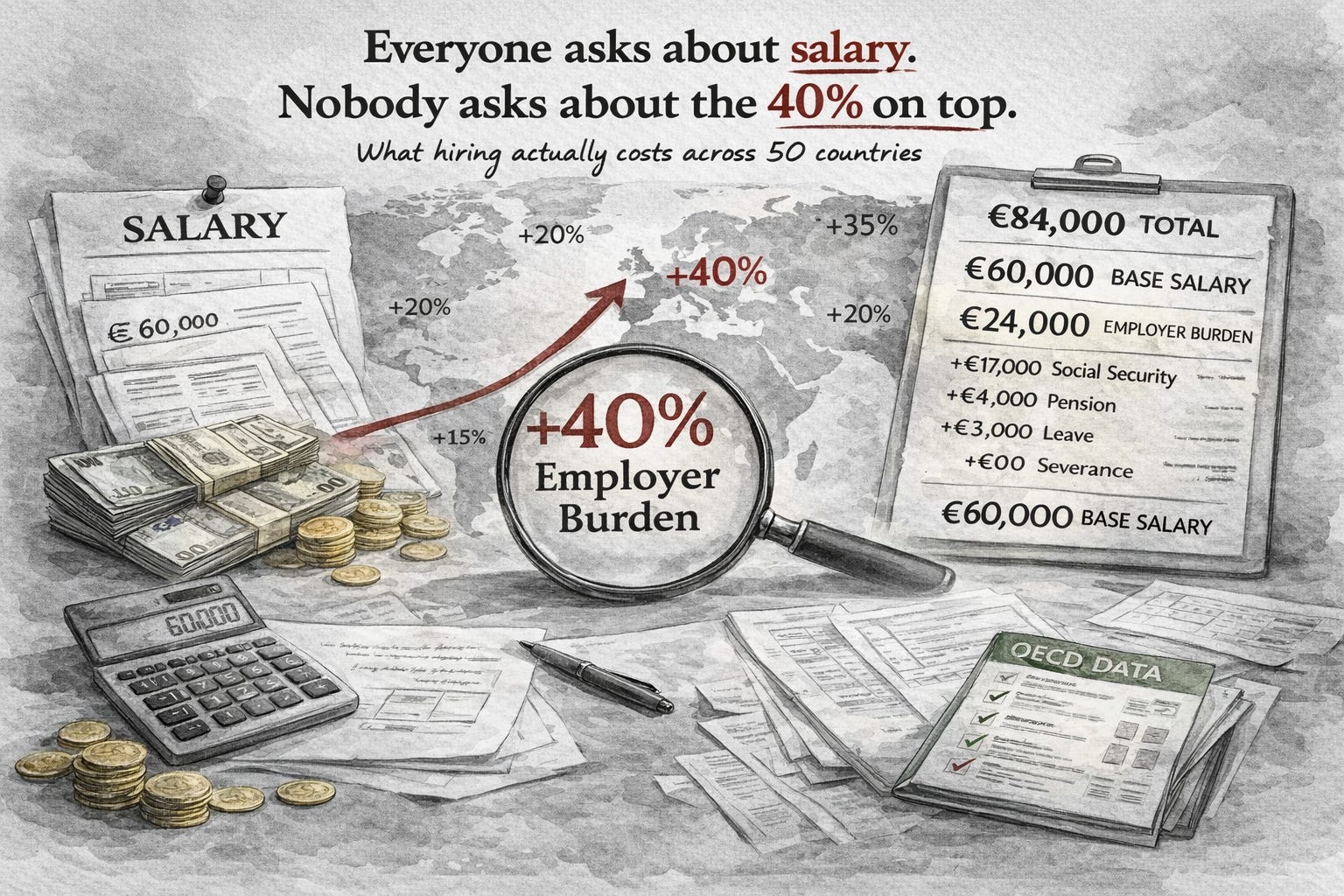
I’ve been pulling data from the OECD to actually map this out across 50 countries. Employer social security rates alone range from under 10% in some countries to over 30% in others. France is the extreme case - total employment costs there run 40-45% above base salary. You hire someone at €60,000 and you’re spending closer to €85,000. That gap is not a rounding error.
Most people think the variance between countries is manageable. It isn’t. The spread between the cheapest and most expensive countries to employ someone is enormous, and it’s not always the countries you’d guess. Some high-salary markets have surprisingly low employer burdens. Some cheaper salary markets hit you hard on contributions.
The dataset I’m building covers employer social security rates, statutory leave entitlements, mandatory pension contributions, and severance exposure - the four things that actually move the number. Not the salary. The stuff wrapped around the salary.
The goal is a simple visualisation tool. You enter a country and a base salary. You get a breakdown of what you’re actually spending. No estimates, no ranges pulled from a consulting deck - OECD data, structured into something you can actually use before you make a hire.
Target date is March 31st, 2026. Still a ways out, but the data work takes time to do properly.
Why does this matter for how companies actually make decisions? Because I keep seeing the same pattern. A company wants to hire in a new country. They look at local salary benchmarks, pick a number that feels competitive, and assume that’s the budget line. Then the invoices start coming in and nothing adds up. The employer burden was never factored in.
This isn’t a niche problem. It affects every company hiring across borders - startups making their first international hire, larger companies growing a regional team, anyone trying to compare the true cost of headcount in Berlin versus Bogotá versus Bangkok.
And it connects directly to why Employer of Record services exist. An EOR doesn’t just handle payroll. It absorbs the local cost structure - registrations, contributions, compliance, all of it. When a company uses an EOR, they’re mainly outsourcing the navigation of exactly this complexity. But you still need to understand the underlying costs, because the EOR fee is built on top of them.
The data is also useful for comparing EOR quotes. If you don’t know what employer social security should cost in a given country, you can’t tell whether a quote is fair or padded.
I’m still adding countries to the dataset. If there’s a market you’re actively hiring in or considering, drop it in the comments. I’ll prioritize based on what’s actually useful to people working through this right now.